Training - Erasmus+
Learning Across Borders: Successful Erasmus+ Training on Non-Formal Education
How can education reach people who often benefit little from traditional learning opportunities? Which approaches strengthen participation, self-confidence and social inclusion? These were some of the key questions explored by 17 professionals from five European partner organisations during a joint online training programme held in June 2026 as part of the Erasmus+ project “Non-Formal Education for Disadvantaged People.” The training was funded through the European Union’s Erasmus+ programme.
The participants represented organisations from Germany, Austria, Italy, Romania and Lithuania, including Caritas of the diocese of Cologne, Caritas Upper Austria, Caritas Alba Iulia, Caritas Trieste and the Carmelite organisation in Kaunas. Since September 2024, these partners have been working together within the Erasmus+ project, exchanging experiences and developing new approaches to educational work with disadvantaged groups. The online training formed another important milestone in this European cooperation.
The course was led by Dr Benjamin Haas, a social scientist and cultural anthropologist based in Cologne. Dr Haas has extensive experience in non-formal education, international cooperation and social work. His training approach combines practical methods with critical reflection on participation, diversity and power relations, helping organisations to design and improve non-formal learning processes in a conscious and sustainable way.
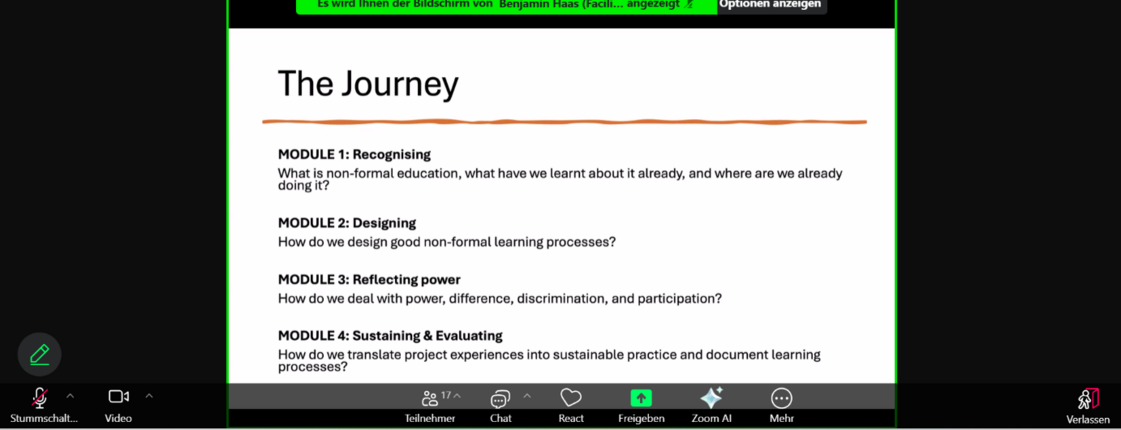
The programme consisted of four online modules, each lasting four hours. The first module focused on developing a shared understanding of non-formal education and encouraging participants to reflect on their own professional practice. Discussions highlighted that many activities already carried out in social work contain important elements of non-formal learning, even if they are not always described in those terms.
The second module addressed quality development in non-formal education. Participants explored the characteristics of successful learning opportunities for disadvantaged target groups and exchanged proven methods from their respective organisations. These
approaches were then adapted and discussed in relation to different national contexts and practical challenges.
The third module focused on power, diversity and participation. Using examples from work with Roma families, refugees and people living in precarious circumstances, participants examined barriers to inclusion and discussed ways of making educational activities more participatory, inclusive and empowering.
The final module concentrated on sustainability and evaluation. Participants considered how project experiences can be embedded in the long-term work of their organisations and explored practical tools for documenting and evaluating learning processes. A particular objective was to develop shared principles of good practice for non-formal education across the European partnership.
Feedback from participants was highly positive. The international exchange of experiences, the practical relevance of the content and the opportunity to learn from different perspectives were especially valued. The training demonstrated the significant added value that European cooperation can bring to the development of social work and educational practice.
More Information: www.nonformal-in-europe.eu